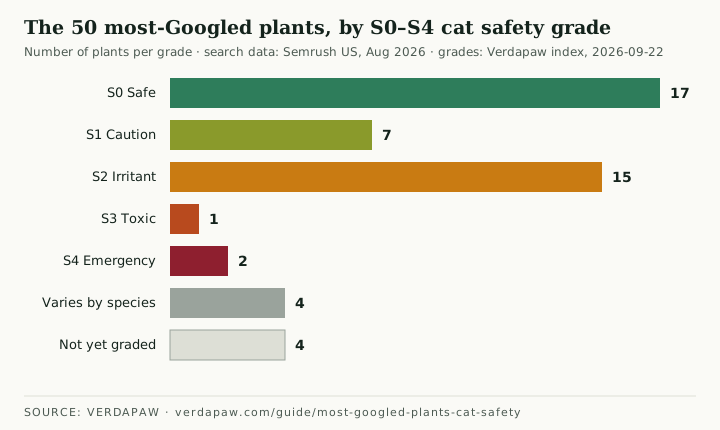
We took Semrush's United States keyword export for August 2026 — 13,625 queries that mention cats and a plant — grouped them by the plant they name, and summed monthly search volume. These are the 50 that came out on top: 571,920 searches a month between them. Each one is then checked against the Verdapaw index. The grade you see is the published S0–S4 verdict for cats, transcribed from ASPCA and Pet Poison Helpline records and reviewed before publication — never inferred from the search data. Where a plant is not in the index yet, we say so; that row is our to-do list, not a verdict. How a source becomes a grade →
| # | Plant | Searches / mo | Cat grade | Verdict |
|---|---|---|---|---|
| 1 | Lily (true lily)“are lilies toxic to cats” | 45,750 | S4 · EMERGENCY | Lily plants of the Lilium genus are life-threatening to cats (S4 Emergency): any amount of leaf, stem, flower, pollen, or even vase water can cause acute kidney failure, and death is possible without early treatment. Full verdict → |
| 2 | Orchid“are orchids toxic to cats” | 41,810 | S0 · SAFE | Orchids (Phalaenopsis, the common moth orchid) are non-toxic to cats (S0 Safe) according to the ASPCA. Full verdict → |
| 3 | Tulip“are tulips toxic to cats” | 37,460 | S2 · IRRITANT | Tulips are toxic to cats (S2 Irritant): tulipalin A and B cause vomiting, drooling, and diarrhea, and the bulb — where the toxin is most concentrated — can cause persistent gastrointestinal distress and lethargy. Full verdict → |
| 4 | Rose“are roses toxic to cats” | 37,190 | S0 · SAFE | Roses are non-toxic to cats (S0 Safe): the ASPCA lists Rosa species as safe, with no toxic principles. Full verdict → |
| 5 | Lavender“is lavender safe for cats” | 34,500 | S1 · CAUTION | Lavender is mildly toxic to cats (S1 Caution): its linalool and linalyl acetate can cause nausea, vomiting, and loss of appetite, but serious poisoning from the plant is not reported by the ASPCA. Full verdict → |
| 6 | Spider plant“are spider plants toxic to cats” | 33,830 | S0 · SAFE | Spider plants are non-toxic to cats (S0 Safe): the ASPCA lists Chlorophytum comosum as safe, with no toxic principles on record. Full verdict → |
| 7 | Pothos“are pothos toxic to cats” | 29,310 | S2 · IRRITANT | Pothos is toxic to cats (S2 Irritant): its insoluble calcium oxalate crystals cause intense oral burning, drooling, and vomiting, but ingestion is rarely life-threatening. Full verdict → |
| 8 | Peace lily“are peace lilies toxic to cats” | 28,520 | S2 · IRRITANT | Peace lily is toxic to cats (S2 Irritant), but it is not a true lily: its insoluble calcium oxalate crystals cause oral burning, drooling, and vomiting — it does not cause the kidney failure that true lilies (Lilium) do. Full verdict → |
| 9 | Snake plant“are snake plants toxic to cats” | 26,990 | S1 · CAUTION | Snake plant is mildly toxic to cats (S1 Caution): its saponins can cause nausea, vomiting, and diarrhea, but serious poisoning is not reported by the ASPCA. Full verdict → |
| 10 | Aloe vera“is aloe plants poisonous to cats” | 23,180 | S2 · IRRITANT | Aloe vera is toxic to cats (S2 Irritant): its saponins and anthraquinones act as purgatives, causing vomiting, diarrhea, and lethargy — though the inner gel itself is considered edible. Full verdict → |
| 11 | Poinsettia“are poinsettias poisonous to cats” | 21,890 | S1 · CAUTION | Poinsettia is only mildly toxic to cats (S1 Caution): its milky sap can cause drooling, vomiting, and skin irritation, but its reputation as a deadly plant is greatly exaggerated — signs are usually self-limiting. Full verdict → |
| 12 | Monstera“are monsteras toxic to cats” | 17,290 | S2 · IRRITANT | Monstera is toxic to cats (S2 Irritant): its insoluble calcium oxalate crystals cause intense oral irritation, drooling, and vomiting, but ingestion is rarely life-threatening. Full verdict → |
| 13 | Dracaena“dracaena toxic to cats” | 15,090 | S2 · IRRITANT | Dracaena — including the plant sold as lucky bamboo — is toxic to cats (S2 Irritant): its saponins cause vomiting (occasionally with blood), drooling, and loss of appetite, with dilated pupils and a wobbly gait reported specifically in cats. Full verdict → |
| 14 | Succulents (unspecified)“are succulents poisonous to cats” | 14,520 | VARIES BY SPECIES | No single grade — the name covers several species with different records. See the Succulents safe for cats → |
| 15 | Philodendron“philodendron toxic to cats” | 13,600 | S2 · IRRITANT | Heartleaf philodendron is toxic to cats (S2 Irritant): its insoluble calcium oxalate crystals cause oral pain, swelling, drooling, and vomiting, but ingestion is rarely life-threatening. Full verdict → |
| 16 | Fern (unspecified)“are ferns toxic to cats” | 12,890 | VARIES BY SPECIES | No single grade — the name covers several species with different records. See the fern guide → |
| 17 | Money tree“are money trees toxic to cats” | 11,630 | S0 · SAFE | Money tree (Pachira aquatica) is non-toxic to cats (S0 Safe): the ASPCA lists it as non-toxic with no toxic principles, noting only that nausea, vomiting, and loose stool can follow eating it. Full verdict → |
| 18 | Sunflower“are sunflowers toxic to cats” | 11,110 | S0 · SAFE | Sunflowers are non-toxic to cats (S0 Safe): the ASPCA lists Helianthus as safe, so a sunflower bouquet on the table or sunflowers in the garden pose no poisoning risk. Full verdict → |
| 19 | Palm (unspecified)“cat palm safe for cats” | 10,420 | VARIES BY SPECIES | No single grade — the name covers several species with different records. See the palm guide → |
| 20 | Bamboo“is bamboo toxic to cats” | 8,400 | S0 · SAFE | True bamboo is non-toxic to cats (S0 Safe): the ASPCA lists Phyllostachys aurea as safe — but the plant sold as 'lucky bamboo' is a different, toxic plant (a Dracaena), not a real bamboo. Full verdict → |
| 21 | Rosemary“is rosemary safe for cats” | 7,870 | S0 · SAFE | Rosemary is non-toxic to cats (S0 Safe): the ASPCA lists Rosmarinus officinalis as safe for cats, dogs, and horses — unlike its windowsill neighbor mint, it carries no essential-oil warning. Full verdict → |
| 22 | Jade plant“are jade plants toxic to cats” | 7,630 | S2 · IRRITANT | Jade plants are toxic to cats (S2 Irritant): the ASPCA lists vomiting, depression, and incoordination as the signs — the toxin itself is unknown, which is a reason for caution, not comfort. Full verdict → |
| 23 | ZZ plant“zz plant toxic to cats” | 7,490 | NOT YET GRADED | Not in the index yet. It is on the roadmap; until it has a sourced, reviewed record we do not publish a grade. |
| 24 | Calathea“calathea toxic to cats” | 6,570 | S0 · SAFE | Calathea is non-toxic to cats (S0 Safe): the ASPCA lists the whole genus (Calathea spp.) as safe for cats, dogs, and horses — pattern varieties like rattlesnake and peacock plants included. Full verdict → |
| 25 | Calla lily“are calla lilies poisonous to cats” | 6,540 | S2 · IRRITANT | Calla lily (Zantedeschia, not a true lily) is an irritant to cats (S2 Irritant): its insoluble calcium oxalate crystals cause intense burning of the mouth, drooling, vomiting, and difficulty swallowing — the same mechanism as peace lily, not the kidney failure of true lilies. Full verdict → |
| 26 | Rubber plant“are rubber plants toxic to cats” | 6,170 | S2 · IRRITANT | Rubber plant (Ficus elastica) is toxic to cats (S2 Irritant): the irritating sap in its leaves and stems causes oral irritation, drooling, and minor gastrointestinal distress, but ingestion is rarely dangerous — unlike the unrelated baby rubber plant (Peperomia), which is non-toxic. Full verdict → |
| 27 | Prayer plant (maranta)“prayer plant toxic to cats” | 4,680 | S0 · SAFE | Calathea is non-toxic to cats (S0 Safe): the ASPCA lists the whole genus (Calathea spp.) as safe for cats, dogs, and horses — pattern varieties like rattlesnake and peacock plants included. Full verdict → |
| 28 | Boston fern“boston fern toxic to cats” | 4,530 | S0 · SAFE | Boston fern is non-toxic to cats (S0 Safe): the ASPCA lists Nephrolepis exaltata as safe for cats and dogs — a true fern with no toxin on record, unlike the asparagus 'fern' that mimics it. Full verdict → |
| 29 | Fiddle leaf fig“are fiddle leaf figs toxic to cats” | 3,990 | S2 · IRRITANT | Fiddle leaf fig (Ficus lyrata) is toxic to cats (S2 Irritant): its irritating sap causes mouth and stomach irritation with drooling and vomiting, and skin irritation on contact, but the ASPCA describes it as only mildly toxic — not life-threatening. Full verdict → |
| 30 | Lilac“are lilacs poisonous to cats” | 3,230 | S1 · CAUTION | Common lilac is low-risk for cats (S1 Caution): Pet Poison Helpline notes garden lilacs are not likely to cause severe symptoms, with large ingestions causing at most mild vomiting or diarrhea — but don't confuse it with Persian lilac (chinaberry), a different and seriously toxic tree. Full verdict → |
| 31 | Hoya“are hoyas toxic to cats” | 3,000 | S0 · SAFE | Hoya is non-toxic to cats (S0 Safe): the ASPCA lists the wax plant (Hoya carnosa) as safe for cats and dogs — the milky sap looks suspicious but carries no toxin on record. Full verdict → |
| 32 | Ficus (unspecified)“ficus plant poisonous to cats” | 2,810 | VARIES BY SPECIES | No single grade — the name covers several species with different records. See the ficus guide → |
| 33 | Parlor palm“parlor palm toxic to cats” | 2,660 | S0 · SAFE | Parlor palm is non-toxic to cats (S0 Safe): the ASPCA lists Chamaedorea elegans — sold as both parlor palm and bamboo palm — as safe for cats, making it one of the few large-form houseplants a cat household can keep without a plan. Full verdict → |
| 34 | Ponytail palm“are ponytail palms toxic to cats” | 2,630 | S0 · SAFE | Ponytail palm is non-toxic to cats (S0 Safe): the ASPCA lists Beaucarnea recurvata as safe for cats, dogs, and horses — despite the name, it's actually a succulent, not a true palm. Full verdict → |
| 35 | Peruvian lily (alstroemeria)“are peruvian lilies toxic to cats” | 2,440 | S1 · CAUTION | Peruvian lily (Alstroemeria, not a true lily) is mildly toxic to cats (S1 Caution): the ASPCA lists it as non-toxic, but Pet Poison Helpline records irritant glycosides that cause mild vomiting and drooling — and states plainly that it does not cause the kidney damage true lilies do. Full verdict → |
| 36 | Umbrella plant (schefflera)“schefflera plant toxic to cats” | 2,320 | S2 · IRRITANT | Umbrella plant (Schefflera, the umbrella tree) is an irritant to cats (S2 Irritant): its calcium oxalate crystals cause intense burning of the mouth, drooling, gagging, and vomiting when chewed — the same mechanism as pothos and peace lily, with throat swelling possible in rare cases. Full verdict → |
| 37 | Areca palm“areca palm safe for cats” | 2,130 | S0 · SAFE | Areca palm is non-toxic to cats (S0 Safe): the ASPCA lists it as safe, making it a good large-plant alternative for cat households. Full verdict → |
| 38 | Tomato plant“are tomato plants toxic to cats” | 1,860 | S3 · TOXIC | Tomato plants are toxic to cats (S3 Toxic): the solanine in the leaves, stems, and green fruit can cause drooling, severe stomach upset, weakness, dilated pupils, and a slow heart rate — the ripe fruit is non-toxic on the ASPCA record. Full verdict → |
| 39 | Asparagus fern“asparagus fern toxic to cats” | 1,850 | S2 · IRRITANT | Asparagus fern is toxic to cats (S2 Irritant): the ASPCA lists repeated skin contact causing allergic dermatitis and berry ingestion causing vomiting, abdominal pain, or diarrhea — and despite the name, it isn't a true fern at all. Full verdict → |
| 40 | Chinese money plant (pilea)“chinese money plant toxic to cats” | 1,770 | NOT YET GRADED | Not in the index yet. It is on the roadmap; until it has a sourced, reviewed record we do not publish a grade. |
| 41 | Gardenia“are gardenias poisonous to cats” | 1,700 | S2 · IRRITANT | Gardenia (cape jasmine) is an irritant to cats (S2 Irritant): the ASPCA lists geniposide and gardenoside as its toxic principles, with mild vomiting or diarrhea and hives as the signs on record. Full verdict → |
| 42 | Mint“is mint plant safe for cats” | 1,540 | S1 · CAUTION | Mint is mildly toxic to cats (S1 Caution): the ASPCA lists garden mint (Mentha) with essential oils causing vomiting and diarrhea with large ingestions — a nibble is unlikely to matter, a feast can. Full verdict → |
| 43 | Jasmine“are jasmine plants toxic to cats” | 1,510 | S0 · SAFE | Jasmine (true jasmine, the genus Jasminum) is non-toxic to cats (S0 Safe) according to the ASPCA — but several unrelated plants sold as jasmine are not, so check that the label says Jasminum. Full verdict → |
| 44 | Lemon tree“are lemon trees toxic to cats” | 1,450 | S2 · IRRITANT | Lemon trees are an irritant to cats (S2 Irritant): the essential oils and psoralens in the peel, leaves, and stems can cause vomiting, diarrhea, depression, and possible dermatitis — the ASPCA notes the fruit itself is edible. Full verdict → |
| 45 | Bird's nest fern“birds nest fern toxic to cats” | 1,430 | NOT YET GRADED | Not in the index yet. It is on the roadmap; until it has a sourced, reviewed record we do not publish a grade. |
| 46 | Majesty palm“are majesty palms toxic to cats” | 1,420 | S0 · SAFE | Majesty palm is non-toxic to cats (S0 Safe): the ASPCA lists Ravenea rivularis as safe for cats, dogs, and horses, so a chewed frond is a plant problem rather than a vet problem. Full verdict → |
| 47 | Sago palm“sago palm toxic to cats” | 1,400 | S4 · EMERGENCY | Sago palm is life-threatening to cats (S4 Emergency): every part of the plant — the seeds most of all — contains cycasin, and any amount can cause liver failure and death, with symptoms sometimes delayed for hours. Full verdict → |
| 48 | English ivy“is english ivy safe for cats” | 1,320 | S1 · CAUTION | English ivy is mildly toxic to cats (S1 Caution): its triterpenoid saponins cause vomiting, abdominal pain, drooling, and diarrhea after ingestion, with the foliage more toxic than the berries — an upset stomach, not a systemic poisoning. Full verdict → |
| 49 | Polka dot plant“polka dot plant toxic to cats” | 1,320 | S0 · SAFE | Polka dot plant (Hypoestes phyllostachya, also sold as freckle face) is non-toxic to cats (S0 Safe): the ASPCA lists it as non-toxic, noting only mild vomiting or diarrhea if it is eaten. Full verdict → |
| 50 | Wax flower“are wax flowers toxic to cats” | 1,280 | NOT YET GRADED | Not in the index yet. It is on the roadmap; until it has a sourced, reviewed record we do not publish a grade. |
42 of the 50 have a published grade; 4 are not yet in the index. Counts, not search volume.
Open data: data.json · chart: chart.svg · CC BY 4.0 with a link back.
On this index, the true lily (Lilium): S4 Emergency, the top grade, and also the single most-Googled plant in the ranking. The record is unusual in two ways — the ASPCA lists the toxic principle as unknown, and Pet Poison Helpline's warning covers every part, "any amount of leaf, stem, flower, pollen, vase water, or rhizome." The outcome the ASPCA records is "kidney failure, and death is possible." The S4 plants in this top 50 are Lily (#1), Sago palm (#47); every other entry grades S3 or below. If a cat has had any contact with a lily, go to a vet immediately — do not wait for symptoms.
The sago palm: S4 Emergency, the same grade as the lily, and the only S4 in this ranking grown as a potted houseplant. Its record reads that every part contains cycasin, "the seeds most of all," and any amount can cause liver failure and death. The ASPCA's sign chain runs "Vomiting, melena, icterus, increased thirst, hemorrhagic gastroenteritis, bruising, coagulopathy, liver damage, liver failure, death." It sits far down the ranking by search volume, well below pothos or monstera, which are S2 irritants. That gap between how often a plant is searched and how dangerous it is, is the reason this page exists. Any contact with a sago palm: vet immediately.
The phrase is used online for lilies, and the record explains why it stuck. Neither the ASPCA nor Pet Poison Helpline gives a timeline for when signs appear: every symptom on the lily record — vomiting, loss of appetite, lethargy, abdominal pain, dehydration, acute kidney failure — is listed with onset not specified in source. And the toxic routes include pollen and vase water, so a cat can be exposed without chewing anything. "Silent" is not a grade, though; S4 is. Pet Poison Helpline's instruction is "Early treatment is vital … following any exposure." Don't wait for a sign to decide. Go now.
Nothing in the primary-source records supports that idea. The ASPCA and Pet Poison Helpline entries we transcribe describe poisonings that happened, and for the highest-grade plants the exposure route does not even require eating: for lilies, pollen and vase water are on the toxic-parts list. Instinct is not in the data; the grade is. 18 of the 42 graded plants in this top 50 are S2 or higher for cats. Use the grade as the guard, not the cat — and if a cat has had contact with an S3 or S4 plant, call your vet.